
Pure solar street lights are excellent — until you get a week of monsoon cloud and the
batteries run flat. Grid-powered lights are reliable — until the supply cuts out, which in much
of rural India happens often. Solar hybrid street lighting solves both problems
by using solar as the primary source and the grid as backup, giving you low running costs
without the risk of dark streets.
How a Solar Hybrid System Works
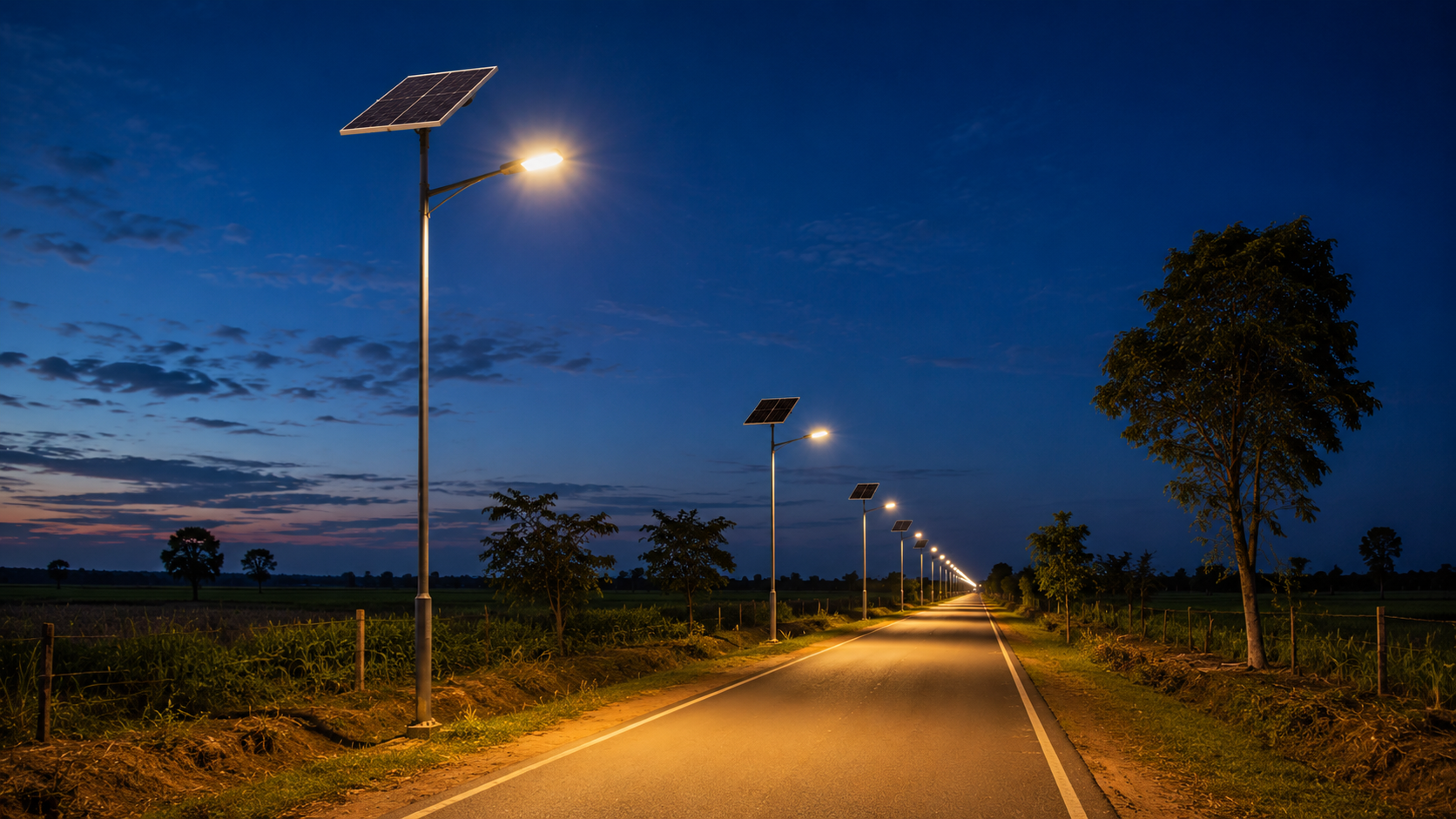
The pole carries a solar panel, a battery, an LED luminaire and a smart controller — plus a
grid connection. The controller prioritises solar: it charges the battery by day and runs the
light from it at night. Only if the battery falls below a safe threshold (after several sunless
days) does it draw from the grid. On most nights, the grid is never touched.
Comparing Your Three Options
| Type | Running Cost | Reliability | Best For |
|---|---|---|---|
| Grid only | Full electricity bill | Depends on supply | Cities with stable power |
| Solar only | Near zero | Weather dependent | Remote, no grid available |
| Solar hybrid | Very low | Highest | Weak or unreliable grid areas |
Where Solar Hybrid Wins in India
- Rural roads and villages with intermittent supply
- Highways and approach roads where trenching cable for kilometres is
expensive - Townships and campuses wanting low bills without reliability risk
- Border, forest and remote installations far from substations
- Areas with frequent outages where lighting is a safety priority
The Battery Decides Everything
More solar installations fail because of batteries than any other component. Older
lead-acid batteries degrade quickly in Indian heat and need replacing within a few years.
LiFePO4 (lithium iron phosphate) batteries handle heat far better, last
considerably longer, and need almost no maintenance. The higher upfront cost is usually the
cheapest decision over the system’s life.
Also specify autonomy — how many sunless nights the system must run
unaided. Two to three days is a sensible target for monsoon regions.
What Else to Specify
- MPPT charge controller — extracts more energy from the panel than
cheaper PWM controllers, especially in weak winter light - Panel sizing matched to local sunlight hours, not a generic figure
- High-efficacy LED (120+ lm/W) — every watt saved shrinks the panel and
battery you need - IP66 weatherproofing and corrosion protection
- Dusk-to-dawn automation and adaptive dimming to stretch battery life
- Anti-theft mounting for panels and batteries in remote locations
- BIS certification and a clear warranty, especially on the battery
The Economics
Solar hybrid costs more upfront than a plain grid light, but eliminates most of the
electricity bill and, on long stretches, saves enormous cabling and trenching cost. For
government and rural projects — supported by India’s renewable push through bodies like the Ministry of New and Renewable
Energy — it often works out cheaper over the project life while improving reliability.
Frequently Asked Questions
What is a solar hybrid street light?
A street light that runs primarily on solar power with battery storage, and automatically
falls back to the grid only when the battery is depleted.
Is solar hybrid better than pure solar?
Where a grid connection exists, yes — you get near-zero running costs plus guaranteed
reliability during long cloudy periods.
How many days of backup should a solar street light have?
Two to three days of autonomy is a sensible target in monsoon-affected regions.
Which battery is best for solar street lights in India?
LiFePO4 lithium batteries — they tolerate heat, last longer and need less maintenance than
lead-acid.
Reway’s solar street lighting range —
SUNRAY, SOLITE, BEAMAX and more — is built for Indian
conditions. Get a solar lighting proposal →