
If your project is chasing a green rating, lighting is one of the easiest places to pick up
points — and one of the easiest to quietly lose them. Lighting touches energy performance,
occupant comfort, and outdoor light pollution, which means it appears across several credit
categories rather than sitting in one box.
The Three Main Rating Systems in India
| System | Run By | Common Use |
|---|---|---|
| IGBC | Indian Green Building Council (CII) | Widely used across Indian projects |
| LEED | US Green Building Council | International recognition, corporates |
| GRIHA | TERI & MNRE | National rating, government projects |
The details differ, but all three reward the same lighting behaviours: use less energy,
control it intelligently, keep light out of the night sky, and make interiors comfortable.
Where Lighting Earns Points
1. Energy efficiency. The biggest opportunity. High-efficacy LED (measured
in lumens per watt) reduces your building’s lighting power density — a core metric in every
rating system. Choosing 130+ lm/W fixtures over budget alternatives directly improves your
modelled energy performance.
2. Lighting controls. Occupancy sensors, daylight dimming, zoning and
scheduling all reduce actual consumption and are specifically credited. Controls are usually
the cheapest points available.
3. Daylight integration. Designing so electric light dims automatically
near windows earns credit and improves occupant experience at the same time.
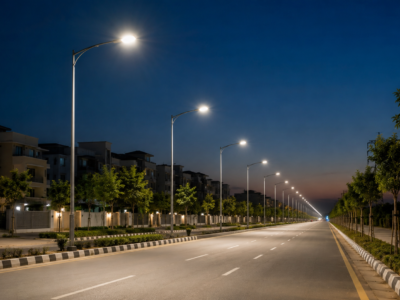
4. Light pollution reduction. Outdoor lighting must be shielded and
controlled so light does not escape upward or trespass off-site. Full-cutoff fixtures and
after-hours dimming are the standard fixes.
5. Occupant comfort and quality of light. Glare control, flicker-free
operation, and good colour rendering (CRI) support the wellbeing-related credits that most
systems now include.
Documentation: The Part Projects Forget
Credits are awarded on evidence, not intent. Assessors typically want fixture datasheets
showing wattage, lumen output and efficacy; independent test reports (LM-79 for
photometric performance and LM-80 for lumen maintenance); certification such as
BIS; control strategy
drawings; and outdoor photometric plots proving light does not spill off-site.
Choose a supplier who can produce all of this on request. Chasing missing documentation late
in a project is a common and avoidable delay.
A Practical Lighting Strategy for Certification
- Specify high-efficacy LED throughout (target 130+ lm/W)
- Add occupancy sensors in intermittently used spaces
- Use daylight-linked dimming near windows and atria
- Zone lighting so unused areas are not lit
- Use shielded outdoor fixtures with after-hours dimming
- Specify glare-free, flicker-free, CRI 80+ interior fixtures
- Collect LM-79, LM-80 and BIS documentation from day one
India’s Bureau of Energy
Efficiency also promotes efficient lighting standards that align closely with these
requirements.
Frequently Asked Questions
Does lighting affect green building certification?
Yes — lighting influences energy efficiency, controls, daylight, light pollution and
occupant comfort credits across IGBC, LEED and GRIHA.
What documents do assessors need for lighting?
Fixture datasheets with efficacy, LM-79 and LM-80 test reports, BIS certification, control
strategies, and outdoor photometric plots.
Which is easier to earn — efficiency or controls credits?
Controls are usually the cheapest and quickest wins, while high-efficacy fixtures deliver
the largest overall energy improvement.
Do outdoor lights affect certification?
Yes. Uncontrolled outdoor light that spills off-site or upward can cost you light-pollution
credits.
Reway supplies BIS-certified, high-efficacy
LED lighting with full LM-79 and LM-80 documentation for green building projects. Request documentation for your project →