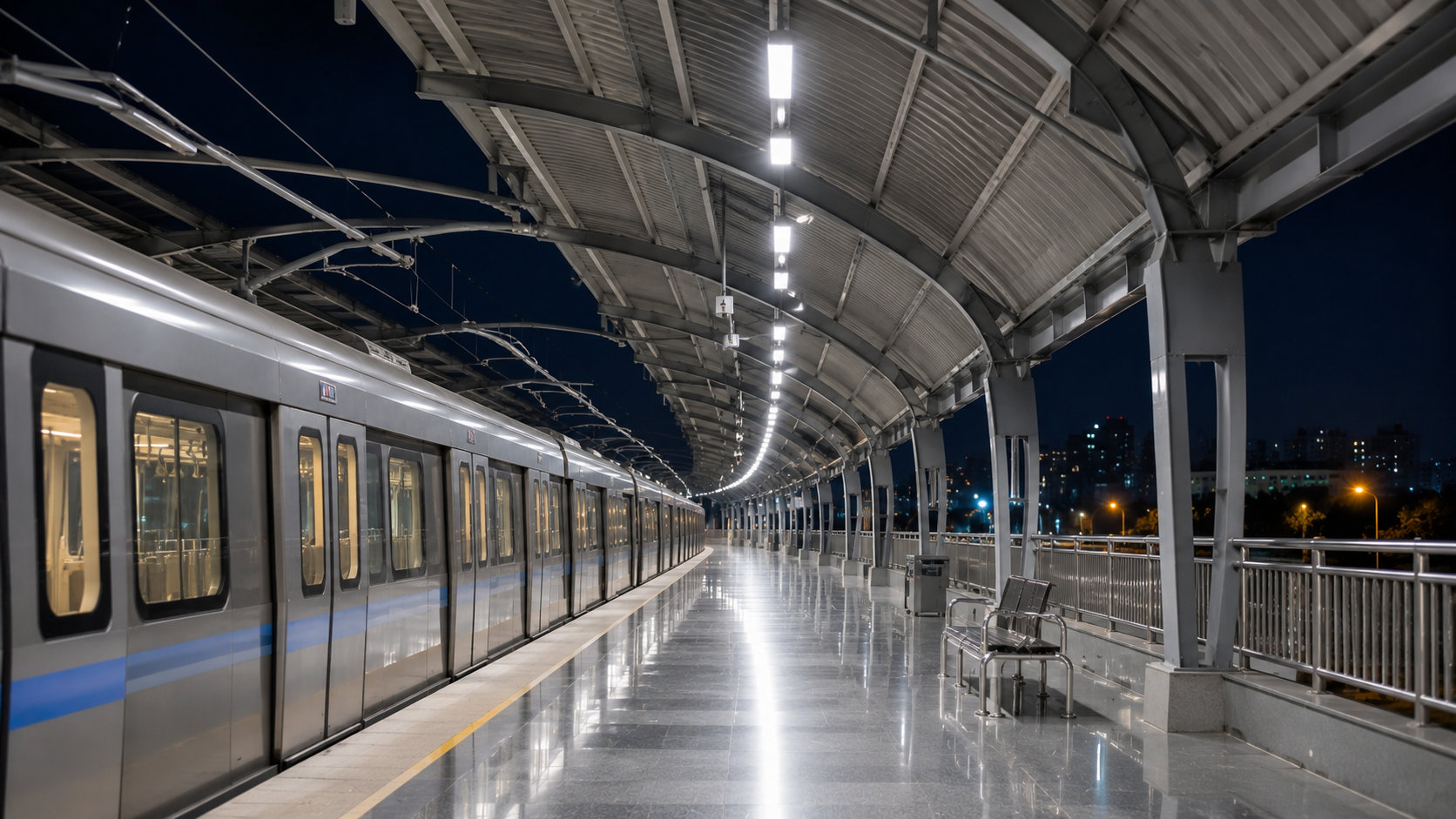

Lighting a transport facility is not the same as lighting a building or a road. Passengers
move in crowds, staff work around live tracks and moving aircraft, operations run 24 hours, and
a failed light is a genuine safety issue rather than an inconvenience. Metro stations, railway
yards and airport aprons each place demands on lighting that ordinary commercial fixtures were
never designed to meet.
Why Transport Lighting Is a Different Discipline
- Continuous operation: many areas run 24/7, so efficiency and lifespan
matter far more than in a nine-hour office. - Safety-critical: platform edges, staircases, level crossings and aprons
need dependable, uniform light with no dark patches. - Hard access: replacing a fixture over a live track or an active apron may
require possession, shutdown or specialist equipment. - Vibration and weather: passing trains, aircraft, dust, humidity and heat
punish poorly built fittings. - Glare control: light must never compromise signal visibility for drivers,
pilots or operators.
Typical Light Levels by Area
| Area | Indicative Lux | Priority |
|---|---|---|
| Platforms | 150–300 lux | Uniformity, edge visibility |
| Concourse / ticketing | 200–400 lux | Wayfinding, signage clarity |
| Stairs, escalators, subways | 150–250 lux | Step definition, safety |
| Underground platforms/tunnels | 200–300 lux | No daylight, needs consistency |
| Railway yards & sidings | 50–100 lux | Wide area, high mast coverage |
| Maintenance sheds | 300–500 lux | Detailed technical work |
| Airport aprons | 100–200 lux | Wide coverage, strict glare control |
| Car parks / drop-off | 75–150 lux | Safety and surveillance |
Wide Open Areas Need High Masts
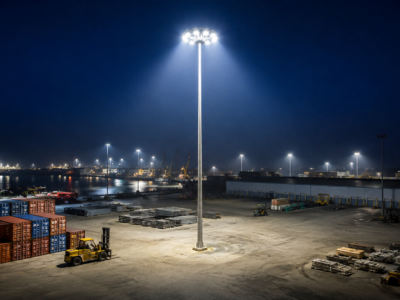
Railway yards, container terminals and airport aprons cannot practically be lit by ordinary
poles. High masts of 20–40m
carrying a cluster of floodlights cover vast areas from few positions — critical where every
obstruction is an operational hazard. The winch system matters enormously here: lowering the
lantern carriage to ground level means maintenance without shutting down the area.
Specifications That Matter Most
- IP66 and vibration-resistant construction for trackside and apron use
- Surge protection (up to 10KV) — transport power networks see spikes
- Flicker-free operation — essential where CCTV records continuously
- High CRI so signage, signals and colour codes read correctly
- Uniformity, not just average lux — dark patches at platform edges are
unacceptable - Long life and easy access to minimise disruptive maintenance
- Emergency lighting integration for evacuation routes
Controls and Energy
Transport facilities run enormous connected loads, so controls pay back quickly. Zoning
lets you light only active platforms; scheduling reduces output during low-traffic overnight
hours; daylight sensing dims lighting in areas with natural light. A CCMS adds remote monitoring and instant
fault alerts — invaluable across sprawling sites where nobody may notice a failure for days.
Compliance and Documentation
Transport projects are almost always public procurement, so compliance is mandatory.
Expect to provide BIS
certification, CRS registration, LM-79 and LM-80 test reports, IP/IK ratings and NABL-accredited
test results for the exact models supplied — along with a lighting design proving the required
lux and uniformity.
Frequently Asked Questions
How much light does a railway platform need?
Typically 150–300 lux with strong uniformity, ensuring platform edges and stairs are clearly
visible.
Why are high masts used in railway yards and airports?
They light very large open areas from few positions, reducing obstructions, and their winch
systems allow maintenance without shutting operations down.
What IP rating is needed for trackside lighting?
IP66 as a minimum, along with vibration-resistant construction and surge protection.
Does transport lighting need flicker-free fixtures?
Yes — continuous CCTV recording and safety-critical visual tasks both require flicker-free
operation.
Reway supplies BIS-certified lighting and high masts for transport infrastructure, with
complete documentation and lighting designs — backed by Vishal Technopower’s 30+ years of EPC
experience. Discuss your infrastructure project →