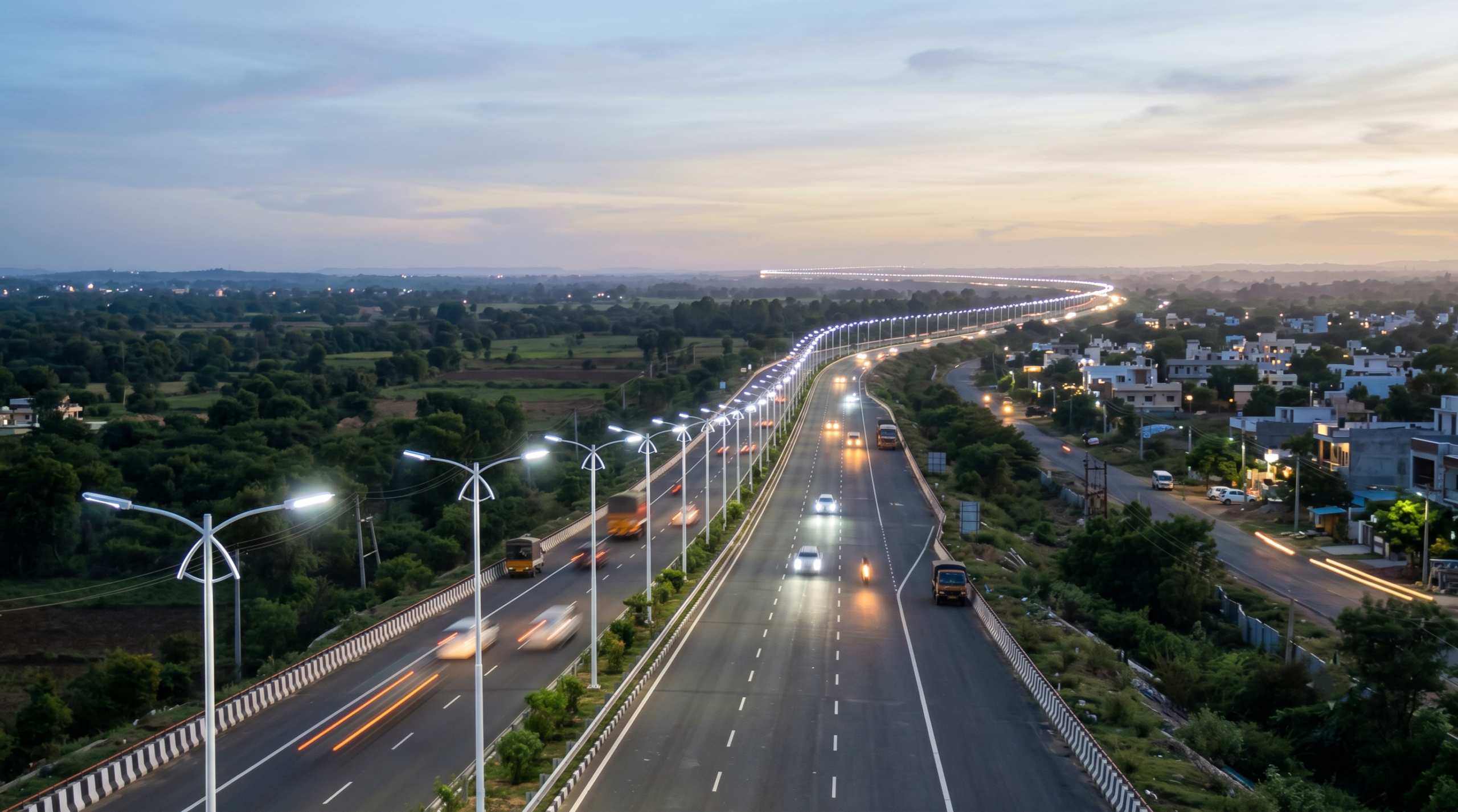

Choosing an LED street light sounds simple — until you’re staring at a spec sheet full of wattages, lumens, lm/W, IP ratings, and CCT values. Pick wrong, and you either overpay for energy or leave dark patches on the road that compromise safety. Whether you’re a municipal engineer planning a city tender, an EPC contractor sourcing for a highway, or a builder lighting a township, this guide breaks down every factor that actually matters — in plain language — so you can specify the right street light with complete confidence.
Brightness: Why Lumens Beat Watts
For decades, people bought lights by wattage — a 250W lamp meant a known brightness. With LED, that logic completely breaks down. Watts measure power consumed, not light produced. A modern 100W LED can easily out-shine an old 250W sodium lamp while using less than half the electricity.
The real measure of brightness is the lumen (lm) — the total visible light a fixture emits. When you compare street lights, always compare lumens first, never wattage. A fixture advertised only by its watts is hiding the number that actually matters.
Efficacy (lm/W): The Number That Saves You Money
Luminous efficacy — lumens per watt (lm/W) — tells you how efficiently a fixture turns electricity into light. The higher the number, the less power you burn for the same brightness. This is the single most important specification for any large project.
- Old sodium/HID lamps: approximately 80–100 lm/W
- Budget LEDs: approximately 100–120 lm/W
- Premium LEDs (like Reway NOVA): up to 160 lm/W
Here’s why it matters in rupees. Imagine a project with 1,000 street lights running 12 hours every night. A budget fixture at 110 lm/W versus a premium fixture at 150 lm/W can mean a 25–30% difference in power consumption for the same brightness on the road. Over a 50,000-hour lifespan, that difference adds up to lakhs of rupees in electricity savings — often far more than the upfront price difference.

What Wattage Do You Actually Need?
Once you’re thinking in lumens, wattage becomes a function of the road. Wider, busier roads need more light on the ground (measured in lux), while quiet residential lanes need less. Here’s a practical starting point for Indian roads:
| Road Type | Typical LED Wattage | Reway Series |
|---|---|---|
| Residential lanes & pathways | 20W – 45W | LITE |
| City roads & approach roads | 60W – 130W | LITE+ / NOVA |
| Main roads & arterial roads | 150W – 180W | RAYA / NOVA |
| Highways & expressways | 180W – 350W | NOVA PRO / ALON |
Remember, this is a starting point, not a final answer. Pole height, road width, and fixture spacing all affect the final lighting design.
Pole Height & Spacing: The Hidden Factors
Two identical fixtures can light a road brilliantly or leave dark gaps, depending entirely on how they’re mounted. Higher poles spread light across a larger area but reduce intensity on the road surface, meaning taller poles require higher lumen output. Wider spacing between poles also demands more powerful fixtures to maintain uniform lighting.
As a rough guide, residential roads typically use 5–8 metre poles, main roads use 8–10 metre poles, and highways use 10–12 metre poles or high masts. The goal is uniform lighting — not bright spots directly beneath each pole. A professional supplier should provide a Dialux lighting simulation showing exactly how light will fall on your road before installation.
IP & IK Ratings: Built for Indian Weather
Street lights face monsoon rain, dust storms, pollution, and extreme temperatures. Two ratings are especially important:
- IP Rating (Ingress Protection): Look for IP66 — fully dust-tight and protected against powerful water jets. Anything lower may struggle in Indian monsoon conditions.
- IK Rating (Impact Protection): Choose IK08 or higher to withstand vandalism, stone impacts, and accidental damage.
India Tip: For coastal cities and industrial areas, also ask about surge protection. Reway street lights include built-in surge protection up to 10KV to withstand voltage fluctuations and power spikes common in many regions.
Colour Temperature (CCT) for Roads
CCT (Correlated Colour Temperature), measured in Kelvin (K), determines the colour appearance of the light. For street lighting, 4000K–5700K (neutral to cool white) is the industry standard because it delivers excellent visibility and contrast for drivers and pedestrians.
Warmer light (around 3000K) is sometimes selected for heritage districts or areas concerned about light pollution. However, cool white remains the preferred option for most roads and highways. Reway street lights are typically rated at 5700K ± 500K — an ideal balance for road safety.
BIS & Certifications to Demand
In India, especially for government and infrastructure projects, certifications are proof of quality, safety, and compliance. Always ask for:
- BIS Certification — mandatory compliance with Indian standards
- LM-79 — verified photometric performance and efficacy data
- LM-80 — verified lumen maintenance and LED lifespan testing
- IP66 / IK08 — weather and impact protection certification
- CRS Approval — Compulsory Registration Scheme compliance
A supplier who cannot provide these documents should be treated as a red flag. Reway provides complete certification documentation with every product, backed by Vishal Technopower’s 30+ years of EPC experience.
Don’t Forget Warranty & After-Sales Support
A street light is a long-term investment expected to perform for 7–10 years. The lowest purchase price often becomes the most expensive option once replacement costs and maintenance labour are considered.
Ask the following questions:
- Is there a 5-year warranty?
- Is on-site support available?
- Does the supplier have a pan-India service network?
- How quickly are warranty claims resolved?
Reliable after-sales support is often worth far more than a small saving on the initial purchase price.
Your Quick Buyer’s Checklist
- Compare lumens, not just wattage
- Demand 130+ lm/W efficacy for large projects
- Match wattage to both road type and pole height
- Insist on IP66 + IK08 protection
- Choose 4000K–5700K colour temperature
- Verify BIS, LM-79, LM-80, and CRS documentation
- Check for surge protection up to 10KV
- Confirm warranty coverage and service support
Frequently Asked Questions
How many lumens should a street light have?
It depends on the road category. Residential lanes may require 2,000–5,000 lumens per fixture, while highways may need 20,000+ lumens. Always match lumens to the required lux level on the road surface.
What is the best wattage for a street light in India?
For most city roads, 60W–130W LED fixtures are suitable. Highways generally require 180W–350W. Final wattage should be confirmed through a lighting layout and Dialux simulation.
What does IP66 mean for street lights?
IP66 means the fixture is fully protected against dust ingress and resistant to powerful water jets, making it ideal for Indian weather conditions.
Are LED street lights worth the cost?
Yes. LED street lights typically reduce energy consumption by 50–70%, last over 50,000 hours, and significantly reduce maintenance costs, resulting in a strong return on investment.
Which certifications are required for street lights in India?
BIS certification and CRS registration are essential. LM-79 and LM-80 reports provide independent verification of brightness, efficiency, and long-term performance.
Need Help Choosing the Right Street Light?
Reway’s engineering team offers free lighting layout consultations for road, highway, township, industrial, and smart-city projects across India.
→ Talk to Our Engineers