
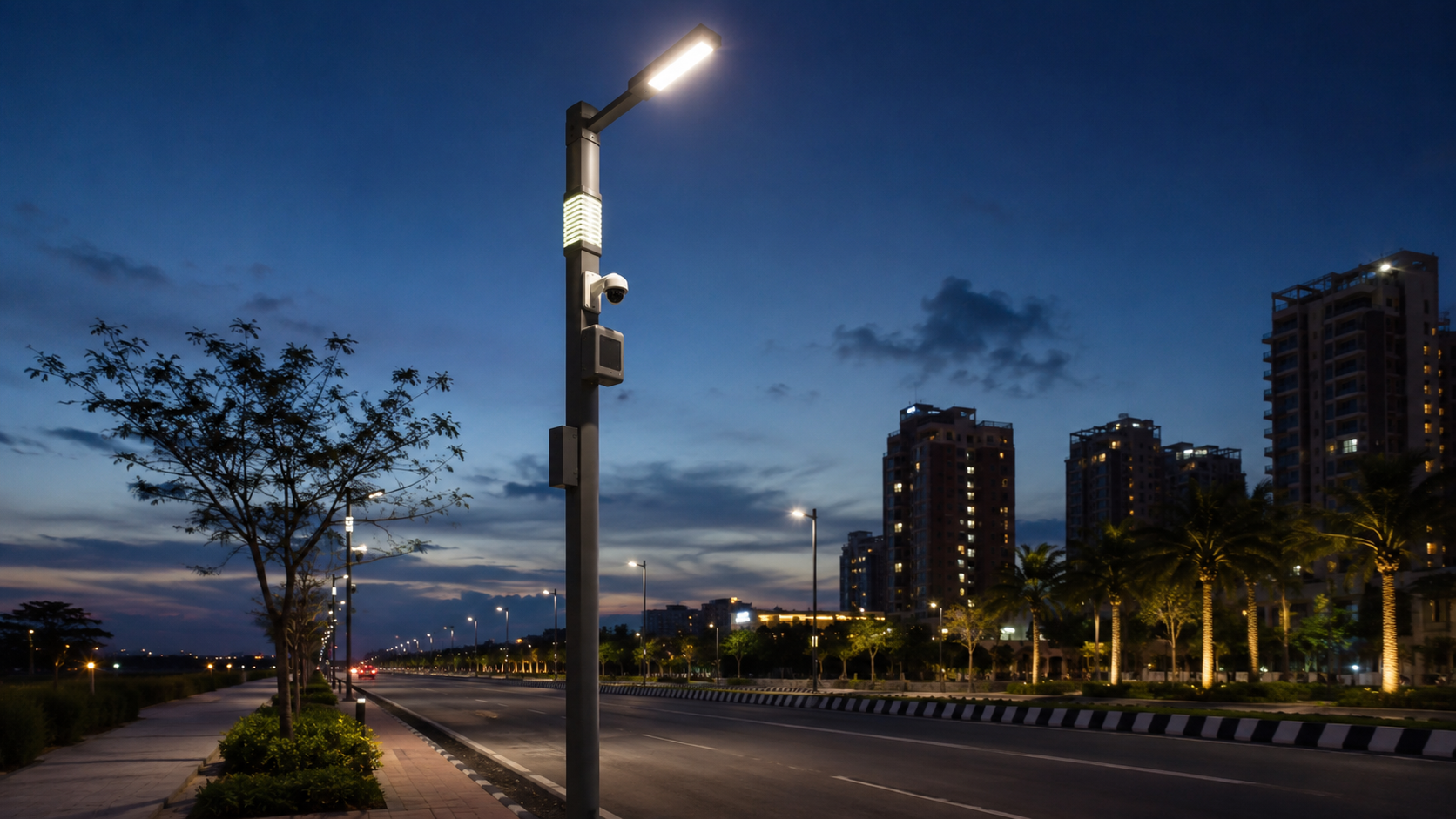

For a century, a street light pole did one job: hold a light. That is changing fast. Across
India, the humble pole is becoming the most valuable piece of real estate in the city — a
vertical platform carrying LED lighting, CCTV, environmental sensors, public Wi-Fi, 5G small
cells, and even EV charging points. These are smart poles, and they are
reshaping how cities plan infrastructure.
Why Smart Poles Are Suddenly Everywhere
Three forces are driving adoption at once. First, cities under the Smart Cities Mission need
digital infrastructure but have limited street space. Second, telecom operators need thousands
of low-height mounting points for 5G small cells. Third, EV adoption is racing ahead and
chargers need to live somewhere. A pole already stands on every street, already has power, and
already belongs to the municipality — making it the obvious host.
Globally, more than 65% of new pole deployments now combine lighting with at least one
other function such as surveillance, EV charging, or small cells.
What Goes On a Smart Pole?
| Module | What It Does | Who Benefits |
|---|---|---|
| LED luminaire | Core street lighting, dimmable | City, public |
| CCMS / IoT controller | Remote control, fault alerts, energy data | City ops |
| CCTV camera | Surveillance, traffic monitoring | Police, traffic |
| Environmental sensors | Air quality, noise, temperature | City, citizens |
| Public Wi-Fi / 5G small cell | Connectivity coverage | Telecom, public |
| EV charging point | Kerbside vehicle charging | EV owners, city |
| Digital signage / PA | Information, emergency alerts | City, public |
The Structural Reality Buyers Miss
Here is what trips up first-time buyers: a smart pole is not a normal pole with gadgets
strapped on. Adding cameras, antennas, and chargers changes the wind load, weight
distribution, and cabling requirements. It needs:
- Heavier-gauge steel and correct wind-zone engineering for your region
- Hot-dip galvanising for decades of corrosion resistance
- Internal cable routing and multiple access doors for different service teams
- Separate compartments so a telecom engineer does not open the electrical panel
- Proper earthing and surge protection for sensitive electronics
Get the structure wrong and you inherit a maintenance nightmare. This is why the pole itself
deserves as much attention as the technology bolted to it.
Cost: Why the Sticker Price Misleads
A smart pole costs several times a plain pole. But compare it correctly — against the cost
of installing a light pole, a separate camera pole, a separate charger post, and a small-cell
mast, each with its own civil work, cabling, and permissions. Consolidating into one structure
usually wins on total cost, and it frees up footpath space.
Many cities also generate revenue from smart poles by leasing space to telecom operators or
advertisers — turning a cost centre into an income stream.
How to Plan a Smart Pole Project
- Decide functions first: lighting is a given; which of CCTV, Wi-Fi, EV,
sensors do you actually need in year one, and which in year five? - Design for future modules: specify spare capacity, ducts, and mounting
points now — retrofitting later is expensive. - Agree ownership: who owns, powers, and maintains each module? This is
the single biggest cause of stalled smart pole projects. - Insist on CCMS: without centralised monitoring, you cannot manage the
lighting layer efficiently — and lighting is what pays the energy bill. - Check certifications: BIS-certified luminaires, galvanising to standard,
and structural certification for your wind zone.
Start Simple: Smart-Ready Poles
You do not have to buy everything at once. A practical route for most municipalities and
townships is a smart-ready pole: a properly engineered galvanised pole with a
high-efficacy LED luminaire and a CCMS node, plus the ducting and mounting provisions to add
cameras, sensors, or chargers later. You get the energy savings immediately and keep the door
open for the rest.
Frequently Asked Questions
What is a smart pole?
A smart pole is a street light pole that also carries digital infrastructure — typically
CCTV, sensors, Wi-Fi or 5G small cells, and sometimes EV charging — managed remotely.
Are smart poles used in India?
Yes. Under the Smart Cities Mission, cities across India have deployed poles combining
energy-efficient LED lighting with air-quality sensors, Wi-Fi, cameras and EV charging.
Do smart poles need special structural design?
Yes. Extra modules add weight and wind load, so smart poles need heavier engineering,
wind-zone certification, internal cabling and separate service compartments.
Can I upgrade existing poles to smart poles?
Sometimes — but usually only for light modules. Cameras and chargers often require a
structurally rated pole, so new smart-ready poles are the safer route.
Reway supplies hot-dip galvanised
poles and smart-ready structures, BIS-certified LED luminaires, and IoT CCMS — the lighting backbone of any
smart pole programme. Talk to our smart
infrastructure team →