
Ask a factory owner what their lighting costs and most will quote the price on the invoice.
That number is the smallest part of the truth. Over a decade, the fitting you buy is a rounding
error next to what you pay to run it. Understanding this is the difference between a
lighting decision that quietly drains cash and one that pays you back every month.
The Three Costs of Every Light
Every fixture has three costs, and only one is visible at purchase:
- Purchase — the invoice price. Usually under 15% of lifetime cost.
- Energy — electricity to run it, often for 12–24 hours a day. Usually the
largest share by far. - Maintenance — replacements, labour, and the downtime of accessing
fixtures high overhead.
Buying on purchase price alone is optimising the smallest number and ignoring the two big
ones.
Where the Money Actually Goes
| Cost Element | Old HID / Cheap Fitting | Quality LED |
|---|---|---|
| Purchase price | Lower | Higher |
| Energy use | High (wasted as heat) | 50–70% lower |
| Lifespan | ~10,000 hrs | 50,000+ hrs |
| Re-lamping / ballasts | Frequent | Rare |
| Maintenance access | Repeated (costly at height) | Minimal |
| 10-year total cost | Highest | Lowest |
A Simple Way to See It
Take one high bay running 12 hours a day. The electricity it burns in a single year commonly
exceeds what the fixture cost to buy. Now multiply by every fixture and by ten years. This is why
a fitting that costs a little more but uses far less power is not the expensive option — it is the
cheap one, paid differently.
The Maintenance Cost Nobody Budgets
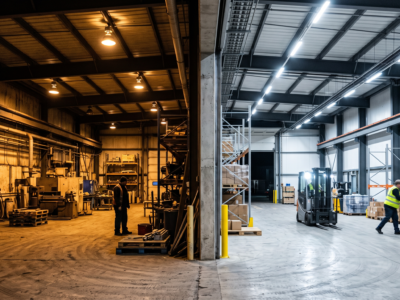
When a fitting fails 9 metres over a running production line, the real cost is not the lamp.
It is the access equipment, the labour, and the production interruption. Long-life LED that runs
50,000+ hours turns dozens of these events into almost none — often the biggest saving after
energy, and the one owners consistently underestimate.
Efficacy: The One Spec That Drives Lifetime Cost
Because energy dominates, efficacy (lumens per watt) is the number that
decides your lifetime cost more than any other. Budget fittings sit at 100–120 lm/W; quality
fittings reach up to 160 lm/W. Across a plant running long hours, that gap is enormous. India’s
Bureau of Energy Efficiency
promotes exactly this shift to high-efficacy lighting.
How to Make the Right Decision
- Compare on 10-year total cost, not purchase price
- Prioritise efficacy (target 130+ lm/W) for long-run areas
- Value long life where access is difficult or disruptive
- Add controls — light unused zones less (see smart controls)
- Insist on BIS, LM-79 and LM-80 so the savings are real, not claimed
- Match IP rating to the environment to avoid early failure
Frequently Asked Questions
What is the real cost of factory lighting?
Purchase price is usually under 15% of the total; energy and maintenance over the fixture’s
life make up the rest.
How much can LED cut factory lighting costs?
Typically 50–70% on energy, plus large maintenance savings from the far longer LED lifespan.
Why is efficacy so important?
Because energy dominates lifetime cost, higher lumens per watt directly lowers the biggest
part of what lighting costs you.
Is the cheapest fitting ever the right choice?
Rarely for long-run industrial areas — a low price with high energy use and short life costs
more over ten years.
Reway’s industrial LED range —
ULTRABAY, BAYLITE, PROSAFE — is built for low lifetime
cost, with free lighting audits. Get a cost
assessment for your plant →