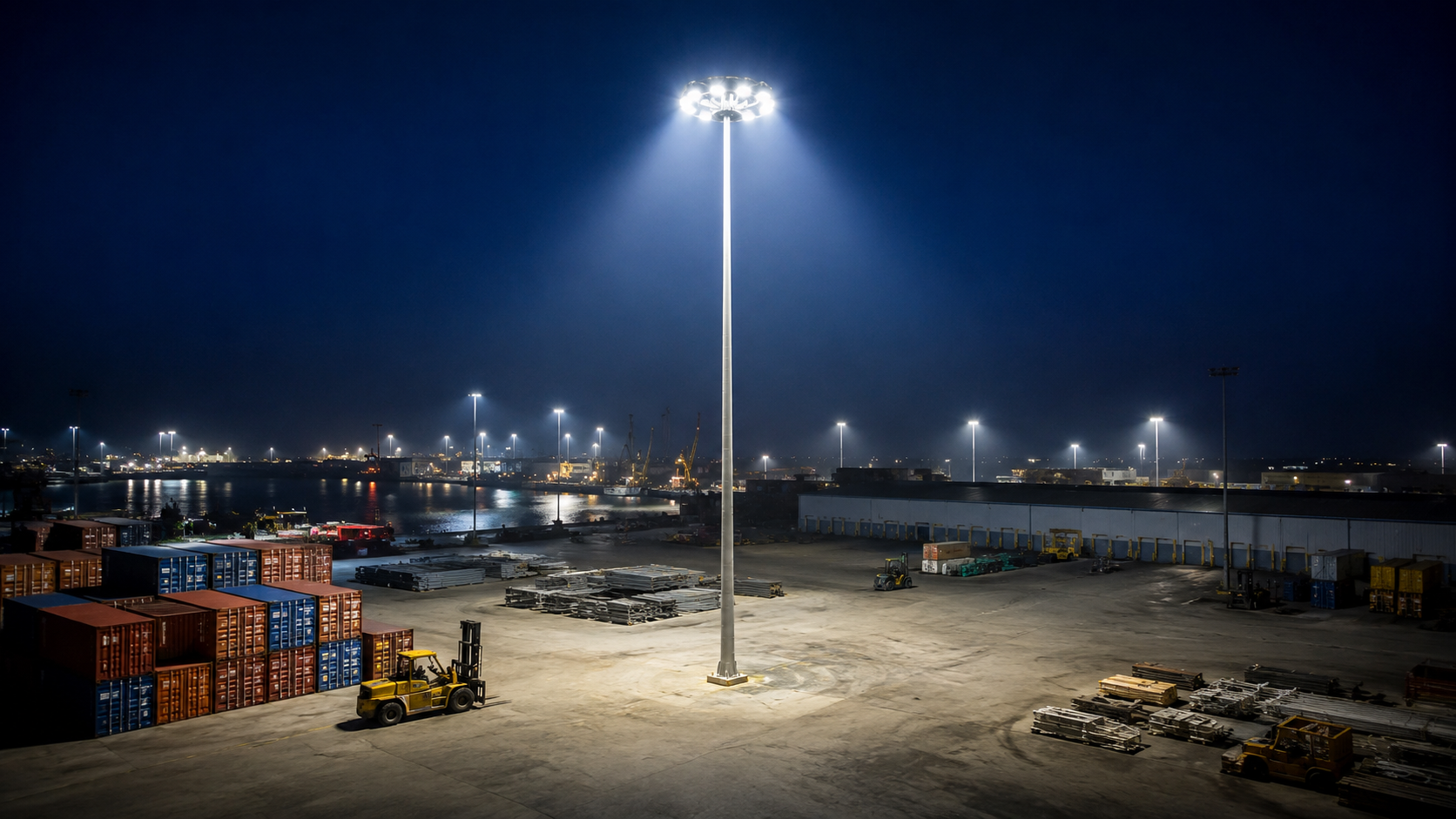

When you need to light a large open area — a port, container yard, highway junction, coal
yard, or stadium — ordinary poles won’t do. You need high mast lighting: tall
towers carrying a cluster of powerful floodlights. But masts are a serious investment and a
safety-critical structure, so specifying correctly matters. Here’s what every buyer, EPC
contractor, and tender official should know.
What Is High Mast Lighting?
A high mast is a tall steel pole (typically 10 to 40 metres) topped with a
ring or frame of floodlights called a lantern carriage. One mast can light a huge area from
above, replacing many shorter poles — ideal for wide, open spaces.
Choosing the Right Mast Height
| Application | Typical Mast Height |
|---|---|
| Parking areas, small yards | 10–16 m |
| Junctions, toll plazas, petrol pumps | 16–20 m |
| Container yards, ports, stadiums | 20–30 m |
| Very large yards, airports | 30–40 m |
The Winch & Lantern System (Why It Matters)
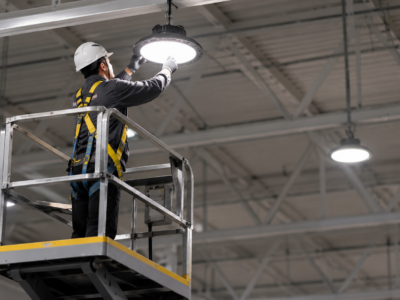
Floodlights sit 20–40m up, so you can’t use a ladder to service them. A high mast has a
winch system that raises and lowers the lantern carriage to ground level for
easy maintenance. Look for: motorized + manual operation, a stainless-steel wire rope
(AISI 316), and a raise/lower speed around 3 m/min. This system is what keeps long-term
maintenance safe and cheap.
Safety: Wind Rating & Galvanising
- Wind rating: masts must be engineered for your region’s wind zone —
quality masts are rated for wind speeds up to 225 km/hr for coastal/high-wind areas. - Hot-dip galvanising: protects the steel from corrosion for decades,
essential outdoors and near coasts (in line with Bureau of Indian Standards norms). - Lightning protection & aviation lights: needed on tall masts.
How to Compare High Mast Quotes (Tender Checklist)
- Mast height + wind-zone certification for your location
- Hot-dip galvanised steel (internal + external)
- Winch system spec (motor, wire rope grade, raise/lower speed)
- Number, wattage, and lux output of floodlights + a lighting design
- Lightning protection and aviation obstruction light
- BIS-certified fixtures and full documentation
Frequently Asked Questions
What is the standard height of a high mast?
Most high masts are 10–40m. Ports, yards, and stadiums typically use 20–30m; very large
areas use up to 40m.
How are high mast lights maintained?
A built-in winch lowers the lantern carriage to ground level, so no crane or climbing is
needed for servicing.
How much wind can a high mast withstand?
Quality masts are engineered to wind-zone standards and can be rated for winds up to
225 km/hr for coastal and high-wind regions.
Reway supplies hot-dip galvanised
high masts (10–40m) with motorized winch systems and BIS-certified floodlights, engineered
for Indian conditions. Get a high mast quote &
design →