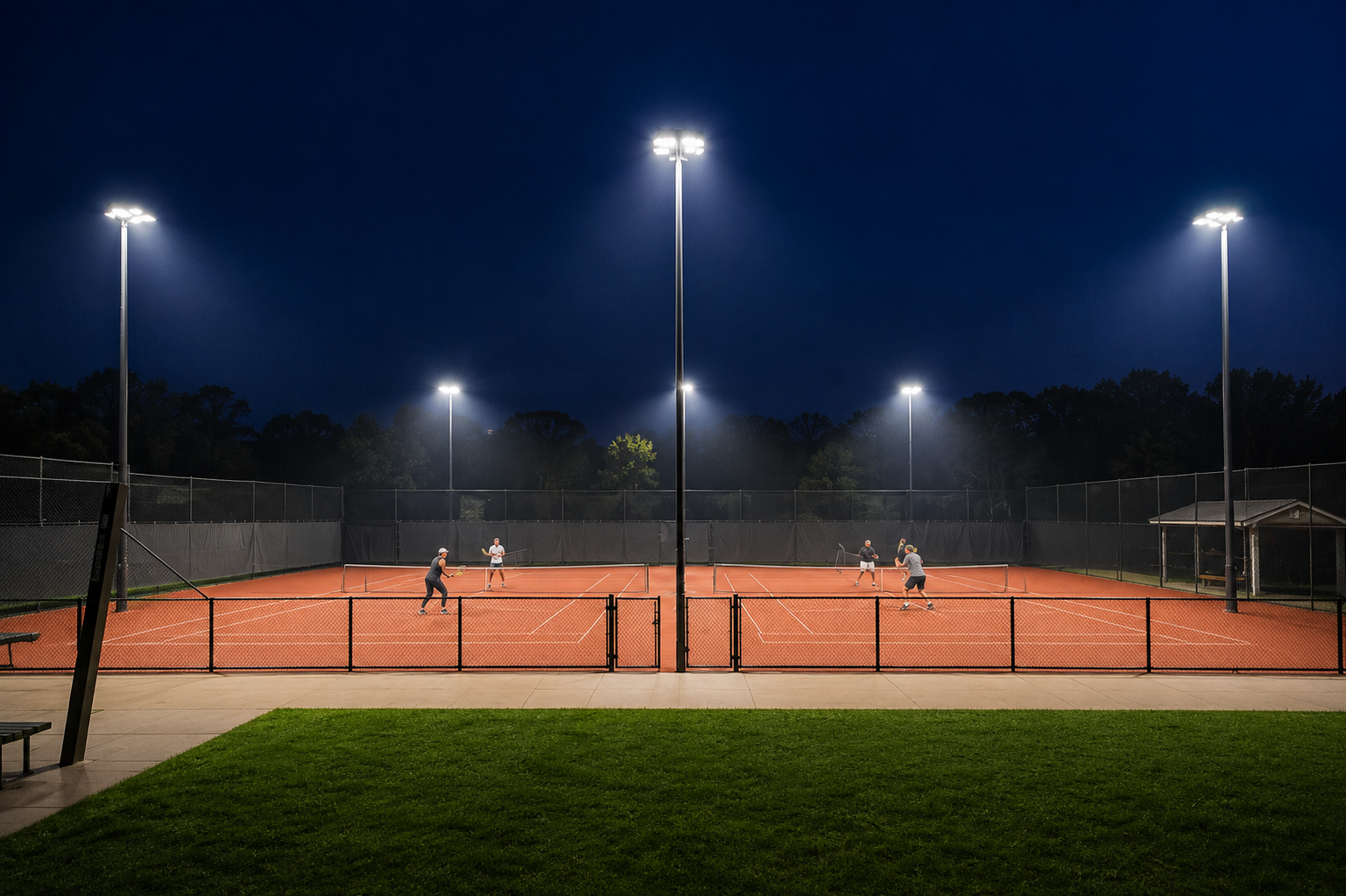

A fast tennis ball is hard to track under bad lighting — dark spots and glare ruin play and
frustrate members. Whether it’s a club, resort, or academy court, here’s how to specify tennis
lighting that players love and that meets recognised standards.
Recommended Lux Levels
| Level of Play | Recommended Lux |
|---|---|
| Recreational / club | 200–300 lux |
| Competition | 300–500 lux |
| Professional / tournament | 500–750+ lux |
Pole Positions Matter
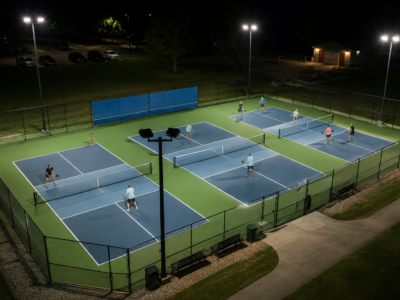
Tennis court lights are mounted on poles along the sides of the court,
clear of the baseline sightlines, so players are never looking into a fixture when they hit
or serve. A common setup uses 4–8 poles at 6–12 metres, cross-lighting the court for even
coverage with no shadows.
Glare & Uniformity
Bodies like the
International Tennis Federation (ITF) publish court lighting recommendations. Two things
separate a good court from a bad one: uniformity (even light
with no dark patches to lose the ball in) and glare control (players and
spectators comfortable, not squinting). Ask for a lighting design showing both.
Indoor & Outdoor Notes
- Outdoor: IP66 weatherproof fixtures; plan for glare and spill control.
- Indoor: even, flicker-free, glare-free light with good CRI.
Buyer Checklist
- Match lux to your level of play
- Side-pole, cross-lit layout for even, shadow-free courts
- Glare-controlled optics and flicker-free drivers
- IP66 fixtures for outdoor courts
- BIS certification and a solid warranty
Frequently Asked Questions
How many lux for a tennis court?
Club play needs 200–300 lux; tournaments need 500–750+ lux.
How many light poles does a tennis court need?
Typically 4–8 poles at 6–12m along the sides, cross-lighting for even coverage.
Are LED lights good for tennis courts?
Yes — LED gives instant, even, flicker-free light with lower energy use and long life.
Reway designs glare-free, even tennis court lighting for clubs, resorts, and academies
using floodlights like ZOLT and VOLTI. Request a court lighting design →