
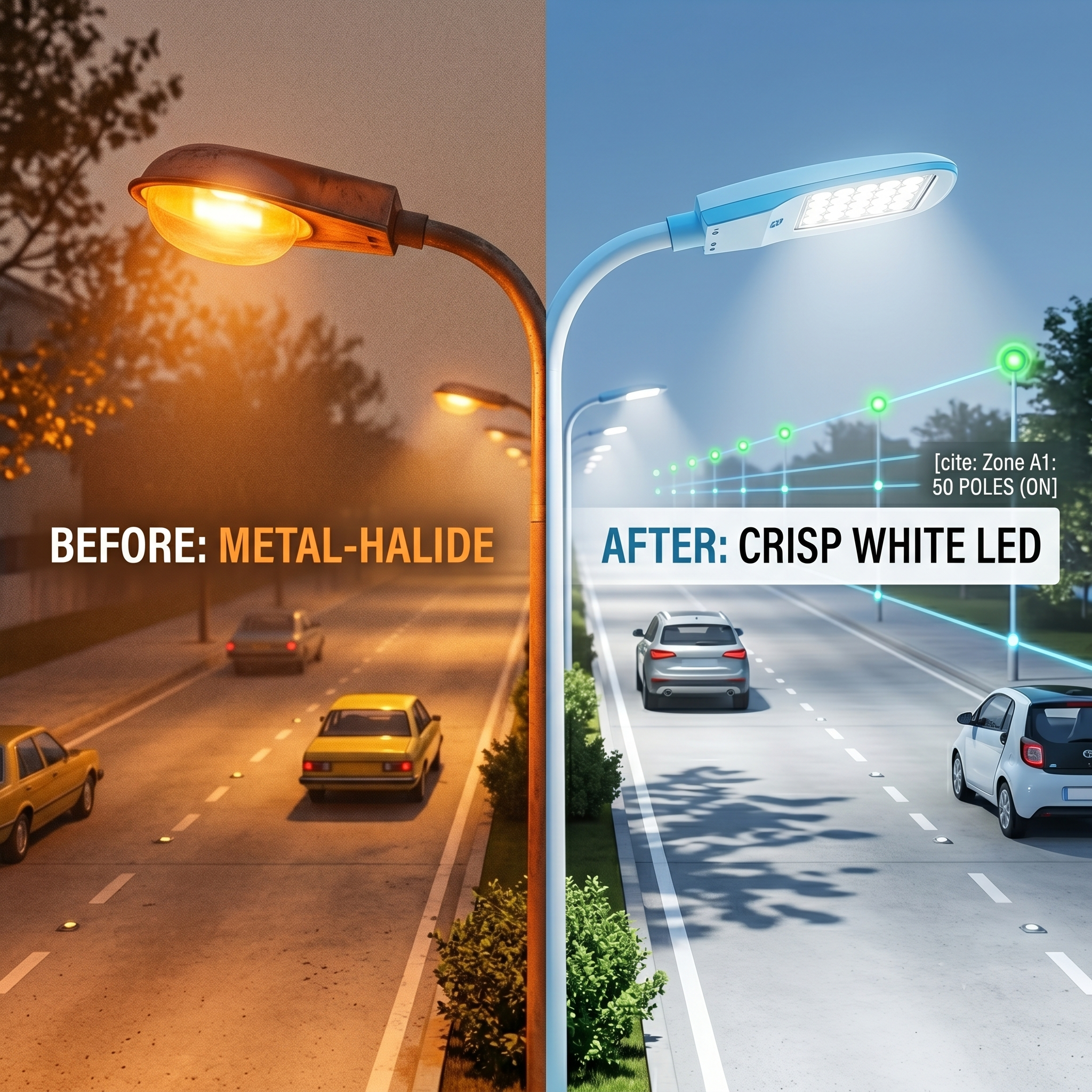

Still running metal halide, mercury vapour, or high-pressure sodium lamps? You’re almost certainly paying far more for electricity than you need to. Switching to LED can cut your lighting energy by 50–70% — but the key is choosing the right LED wattage, which is much lower than your old fixtures. This guide gives you the conversion chart, shows you how to calculate your real payback, and flags the mistakes to avoid.
Why You Need Far Fewer Watts with LED
Old HID lamps are wasteful in two ways: they convert a lot of electricity into heat instead of light, and they throw light in all directions, much of it wasted. LEDs convert more power into usable light and direct it precisely where you want it. That’s why a 400W metal halide can be replaced by a 150W LED — same brightness on the ground, less than half the power. You’re not losing light; you’re cutting waste.
The HID to LED Conversion Chart
Use this as a starting guide. The exact LED wattage depends on the efficacy (lm/W) of the specific fixture you choose — always confirm by matching lumens.
| Old HID / Metal Halide | Equivalent LED | Energy Saved |
|---|---|---|
| 70 W HPS | 20–30 W LED | ~55% |
| 150 W HID | 50–60 W LED | ~60% |
| 250 W HID | 80–100 W LED | ~62% |
| 400 W HID | 120–150 W LED | ~65% |
| 1000 W HID | 300–400 W LED | ~65% |
Always Match by Lumens, Not Just the Chart
The chart above is a guide, but the safest method is to check the lumen output. Find the lumens of your old fixture (or its rated output when new), then choose an LED that delivers similar or slightly higher lumens. Because old lamps lose brightness badly as they age (a 5-year-old metal halide may have lost 30–40% of its output), you can often go even lower in LED wattage than the chart suggests and still get better real-world light.
How to Calculate Your Payback Period
Payback is how long the energy savings take to cover the cost of switching. Here’s a simple four-step method:
- Step 1: Find watts saved per fixture (old watts minus new LED watts). Example: 400W − 150W = 250W saved.
- Step 2: Multiply by hours used per year, then divide by 1000 for kWh saved. Example: 250W × 4,000 hrs ÷ 1000 = 1,000 kWh saved per year.
- Step 3: Multiply kWh saved by your electricity rate. Example: 1,000 kWh × ₹8 = ₹8,000 saved per fixture per year.
- Step 4: Divide the LED’s cost by the yearly saving. Example: ₹4,000 fixture ÷ ₹8,000 = 0.5 year payback.
A Real-World Example
Say a factory has 100 fixtures of 400W metal halide, running 4,000 hours a year, at ₹8/unit. Old consumption: 100 × 400W × 4,000 hrs = 160,000 kWh = ₹12.8 lakh/year. After switching to 150W LED: 100 × 150W × 4,000 hrs = 60,000 kWh = ₹4.8 lakh/year. That’s ₹8 lakh saved every year — plus lower maintenance, since you’re not replacing failed lamps and ballasts on tall fittings.
Don’t Forget the Hidden Savings
Energy is only part of the win. HID lamps need ballast replacements and frequent lamp changes (often every 1–2 years), each requiring labour and access equipment for high mounting. LEDs last 50,000+ hours — often 10+ years — so maintenance costs drop dramatically. Add reduced air-conditioning load (LEDs produce far less heat) and the total savings are even bigger than the electricity bill alone suggests.
Mistakes to Avoid When Converting
- Matching watt-for-watt: Never buy a 400W LED to replace a 400W metal halide — you’ll massively over-light and overpay. Match by lumens.
- Ignoring beam angle: A high-bay LED needs the right beam angle for your ceiling height, or light won’t reach the floor.
- Choosing the cheapest fixture: Low efficacy (lm/W) erases your savings. Insist on 130+ lm/W.
- Skipping certifications: Demand BIS, LM-79, and LM-80 to ensure the brightness and lifespan claims are real.
Frequently Asked Questions
What LED wattage replaces a 250W metal halide?
Typically an 80–100W LED, delivering the same or better brightness with around 60% energy savings.
How much can I save switching from HID to LED?
Most conversions save 50–70% on lighting energy, plus significant maintenance savings from the longer LED lifespan.
What is a good payback period for an LED retrofit?
Many commercial and industrial retrofits pay back within 1.5 to 3 years, then keep saving for the rest of the 50,000-hour life.
Can I reuse my old fixtures or poles?
Often yes — retrofit LED lamps or modules can fit existing housings, though purpose-built LED fixtures usually perform better and last longer.
Do LED replacements need new wiring?
Usually not for a like-for-like swap, but ballasts must be bypassed or removed. A qualified electrician should confirm compatibility with your setup.
Planning a retrofit? Reway can audit your existing lighting and recommend exact LED replacements with a savings estimate. → Get a Free Assessment