
High ceilings make lighting tricky. Put up too few high bay lights and you get gloomy aisles and safety risks; put up too many and you waste money on fixtures and energy you don’t need. The good news: working out the right number and wattage isn’t guesswork. This guide gives you a simple, practical method to light any warehouse, factory, or large space correctly the first time.
What Are High Bay Lights?
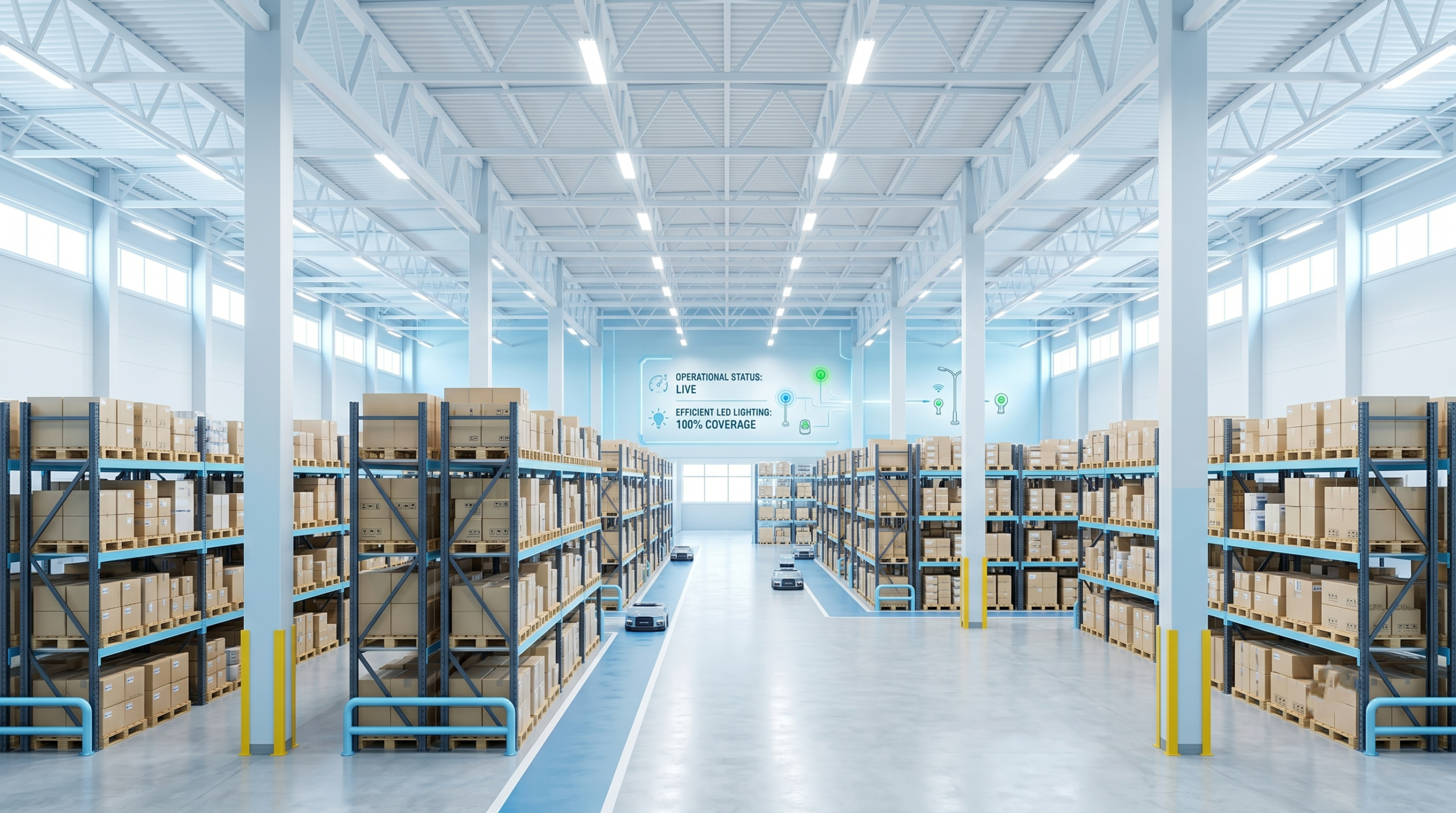
High bay lights are powerful fixtures designed for spaces with ceilings above roughly 12 feet (about 4 metres) — warehouses, factories, gyms, hangars, and large retail. Below that height, the same fixtures are called low bay lights. They come in two main shapes: UFO high bays (round, compact, great for high ceilings and harsh environments) and linear high bays (long, ideal for aisles and assembly lines).
Step 1: Know Your Brightness Need (Lux)
Different tasks need different light levels, measured in lux (lumens landing per square metre). Lighting a storage warehouse to the same level as a precision assembly line wastes money; lighting assembly to mere storage levels is unsafe. A rough guide:
| Space Type | Recommended Lux | Notes |
|---|---|---|
| General warehouse storage | 150–200 lux | Basic movement & storage |
| Picking / packing areas | 300–500 lux | Detail work |
| Manufacturing / assembly | 500–750 lux | Precision tasks |
| Sports / gym halls | 300–500 lux | Activity dependent |
Step 2: The Simple Lumen Rule
Here’s a practical rule of thumb for general lighting: you need roughly 2,000–3,000 lumens per 100 square feet of floor area. So a 10,000 sq ft warehouse needs roughly 200,000–300,000 total lumens. Divide that total by the lumen output of one fixture to estimate how many fixtures you need.
For example: if one high bay produces 20,000 lumens, then 250,000 ÷ 20,000 ≈ 13 fixtures. This gets you a solid starting estimate before fine-tuning for ceiling height and layout.
Step 3: Match Wattage to Ceiling Height
The higher the ceiling, the more powerful each fixture needs to be to push enough light down to the floor:
| Ceiling Height | Typical LED Wattage | Reway Series |
|---|---|---|
| 12–20 ft | 100–150 W | BAYLITE / ULTRABAY |
| 20–30 ft | 150–200 W | ULTRABAY / ORBIT |
| 30 ft and above | 200–250 W | ULTRABAY / ORBIT |
Step 4: Mind the Beam Angle & Spacing
Beam angle decides how light spreads. Higher ceilings need narrower beam angles (60°–90°) to concentrate light down to the floor; lower ceilings use wider beams (90°–120°) for an even spread. Space fixtures so their light pools overlap slightly — a common guideline is to space them about 1 to 1.5 times the mounting height apart. This overlap is what eliminates the dark patches between fixtures that cause safety hazards.
Step 5: Don’t Forget the Environment
Warehouses and factories aren’t gentle places. For dusty, humid, or wash-down areas, choose IP65/IP66-rated high bays. For cold storage, confirm the fixture’s operating temperature range. For high-vibration zones (near heavy machinery), look for robust IK-rated housings. Matching the fixture to the environment prevents premature failures that are costly to replace at height.
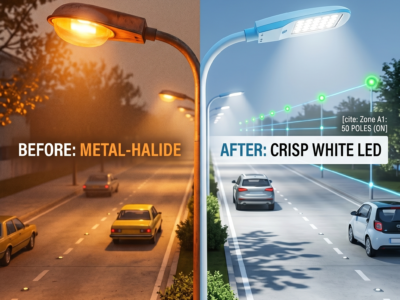
Why LED High Bays Beat Old Metal Halide
- 50–70% lower energy use for the same brightness
- Instant full brightness — no 10-minute warm-up like metal halide
- 50,000+ hour lifespan vs ~10,000 hours, slashing replacement labour on high ceilings
- Better, whiter light (higher CRI) improving worker visibility and safety
- Optional smart controls and motion sensors for further savings
Frequently Asked Questions
How many lumens do I need for a warehouse?
Roughly 2,000–3,000 lumens per 100 sq ft for general storage. Detail or assembly areas need more. Multiply by your floor area and divide by per-fixture lumens to estimate quantity.
What wattage LED high bay replaces a 400W metal halide?
Typically a 100–150W LED high bay matches a 400W metal halide, with far less energy use and better light.
How high should high bay lights be mounted?
High bays suit ceilings above 12 feet. Mounting height drives wattage and beam angle choice — higher ceilings need higher wattage and narrower beams.
What’s the difference between UFO and linear high bays?
UFO high bays are round and compact, ideal for open areas and high ceilings. Linear high bays are long, ideal for aisles and assembly lines.
Do high bay lights need a particular IP rating?
For clean indoor areas, standard ratings are fine. For dust, moisture, or wash-down zones, choose IP65/IP66-rated fixtures for reliable long-term performance.
Send us your floor plan and ceiling height — Reway will design a free high bay lighting layout for your facility. → Talk to Our Engineers