
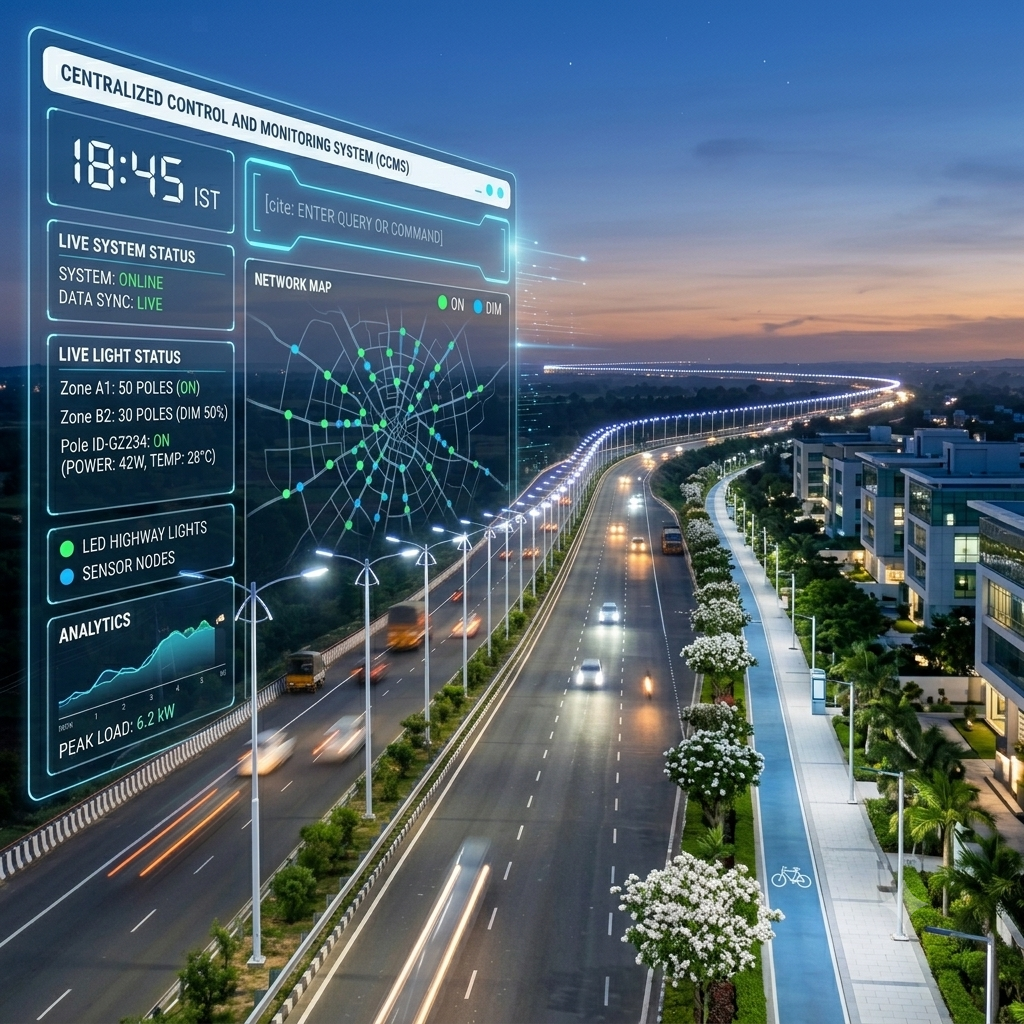

Imagine controlling every street light in an entire city from a single screen — dimming them during quiet hours, spotting a failed light the moment it goes dark, and slashing the power bill by more than half. That’s exactly what a CCMS does. As Indian cities race toward “smart city” goals, this technology has moved from luxury to necessity. Here’s a plain-language guide to what CCMS is, how it works, and why municipalities and industries are adopting it fast.
CCMS, Explained Simply
CCMS stands for Centralized Control and Monitoring System. Think of it as the smart brain that connects all your street lights to one central dashboard, so they can be monitored and controlled remotely — instead of sending a person to drive around and physically check or switch each pole. It turns a “dumb” grid of individual lights into one intelligent, connected network.
Why Traditional Street Lighting Falls Short
Conventional street lights have three expensive problems. First, they run at full brightness all night, even at 3 AM when roads are empty — pure wasted energy. Second, they fail silently: nobody knows a light is out until a resident complains, which can take days. Third, maintenance means manually inspecting thousands of poles. For a city with tens of thousands of lights, this adds up to enormous waste and cost. CCMS solves all three.
How a Smart Lighting System Works
A modern CCMS works in a simple four-step chain:
- Nodes: Each street light gets a small controller that talks wirelessly to its neighbours via a self-healing RF Mesh. (Self-healing means if one node fails, the signal automatically reroutes through another, so the network never breaks.)
- Gateway: A nearby gateway device collects data from hundreds of these light nodes in its area.
- Cloud: The gateway sends all that data to the cloud over the GPRS/GSM mobile network — the same kind of signal your phone uses.
- Manage: City staff log into a web or mobile dashboard to schedule, dim, and monitor every light, and receive instant fault alerts.

Key Terms Decoded (Without the Jargon)
- IoT (Internet of Things): Everyday devices — here, street lights — connected to the internet so they can send data and take commands.
- RF Mesh: A wireless network where each light talks to the next, like a chain of walkie-talkies, covering huge areas without wires.
- GPRS/GSM: Mobile network technology that carries the data from the street to the cloud.
- Astronomical Timer: A smart clock that knows the exact sunrise and sunset for your location every day, so lights switch automatically without manual settings.
What Can a CCMS Actually Do?
- Switch lights on/off automatically at sunrise and sunset using an astronomical timer.
- Dim lights during low-traffic hours to save energy, then brighten them when needed.
- Detect faults and outages instantly, with automatic alerts sent to maintenance teams.
- Track energy consumption and generate detailed reports per zone or per individual light.
- Detect cable theft, power tampering, and abnormal electricity usage.
- Group lights into zones and control each zone independently.
The Real Payoff: Why Cities Choose CCMS
Beyond the convenience, the payoff is money and reliability. Automated dimming and scheduling can cut energy and operational costs by up to 70%. Instant fault detection means safer, always-on streets and far fewer maintenance trips — crews go directly to the fault instead of patrolling. Detailed energy data also helps cities prove savings, plan budgets, and meet smart-city and sustainability targets.
A CCMS doesn’t just save electricity — it transforms street lighting from a constant cost and complaint source into a managed, measurable, and reliable public service.
Where CCMS Is Used
CCMS isn’t only for big cities. It scales from a single industrial campus to an entire metro. Common deployments include:
- Smart cities and municipalities
- Highways and expressways
- Industrial campuses
- Residential townships
- Commercial parks
- Airports and ports
- Large institutional facilities
Frequently Asked Questions
What is the full form of CCMS?
CCMS stands for Centralized Control and Monitoring System — a system that remotely controls and monitors street lights from a central dashboard.
How much can CCMS save on energy?
Through automated scheduling and adaptive dimming, a CCMS can reduce street-lighting energy and operational costs by up to 70%.
Does CCMS work without the internet?
The lights communicate locally via RF Mesh even if the cloud connection drops. Once the GPRS/GSM connection is restored, the system automatically reconnects and syncs the data.
Can CCMS detect a faulty street light automatically?
Yes. The system monitors each light in real time and sends instant alerts when a light fails, voltage drops, or abnormal behaviour is detected — eliminating the need for manual inspection.
Is CCMS suitable for small towns or only big cities?
It scales to any size — from a single campus or a small town to a full metropolitan lighting network.
Why Choose Reway Smart Lighting Solutions?
Reway’s Smart Lighting & CCMS solutions are Made in India and built for cities, highways, industrial campuses, and large-scale infrastructure projects. Backed by Vishal Technopower’s 30+ years of EPC experience, these solutions help organizations reduce costs, improve reliability, and accelerate smart-city adoption.
→ Explore Smart Lighting Solutions | Request a Demo


these blogs are very informative