
Whether you run a cricket academy, manage a club ground, or handle a municipal sports
project, lighting a cricket field is a big decision — and an expensive one to get wrong.
Too little light and play stops at dusk; poor uniformity creates dangerous shadows; bad
glare blinds batsmen and fielders. This guide explains exactly what to look for, what to
demand in a quote, and how to keep running costs down.
How Much Light Does a Cricket Ground Need?
Light on the field is measured in lux. The level you need depends on the
standard of play — recreational nets need far less than a broadcast day-night match. National
bodies like the BCCI follow
strict lighting standards for their match venues.
| Level of Play | Recommended Lux |
|---|---|
| Practice nets / recreational | 200–350 lux |
| Club & district matches | 500–750 lux |
| State / first-class (no TV) | 750–1000 lux |
| International + HD broadcast | 1500–2500+ lux |
The 3 Specs That Actually Matter
When you compare quotes, don’t just look at wattage. Insist on these three numbers:
- Lux level: the average light on the ground for your standard of play.
- Uniformity: how even the light is (no dark patches). Ask for the
uniformity ratio — the higher and more consistent, the safer for players. - Glare control: precise optics that keep light on the field and out
of players’ and cameras’ eyes.
Pole Height & Layout
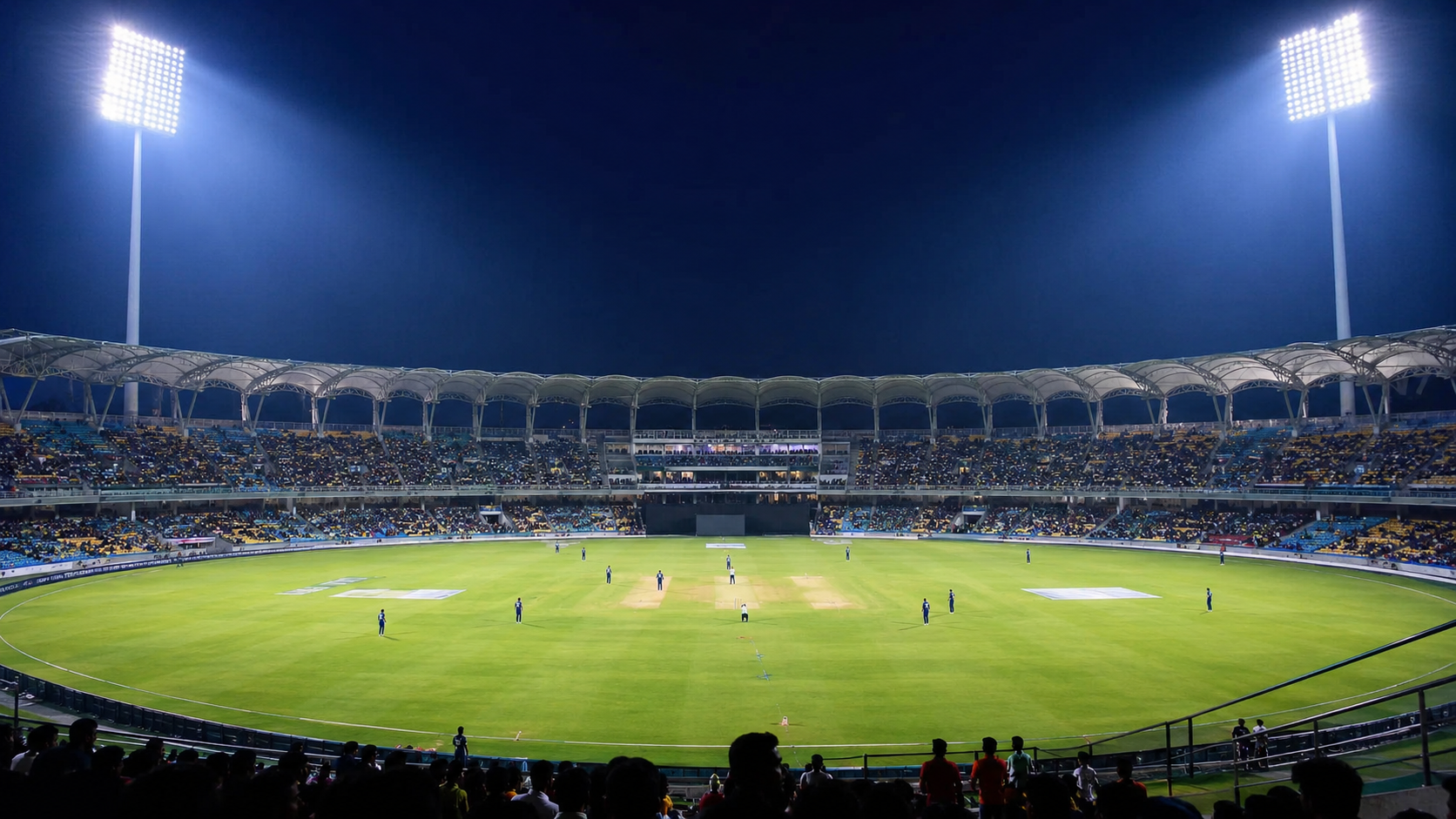
Cricket grounds are large and circular, so light usually comes from tall masts around
the boundary. Higher masts (often 20–40m high masts) give better angles and reduce glare.
The number of masts and fixtures depends on ground size and the lux target — a good supplier
will provide a lighting design (a simulation) showing exactly how light falls before you buy.
Why LED Has Replaced Metal Halide for Cricket
- Instant on/off — no 10-minute warm-up, vital for broadcast and interruptions
- 50–70% lower energy cost — huge for grounds lit for long hours
- Flicker-free for slow-motion replays
- High CRI for true colours on camera
- Far longer life — less maintenance on tall masts
How to Compare Quotes (Buyer Checklist)
- Ask for a lighting design/simulation, not just a price
- Compare on lux + uniformity, not wattage alone
- Confirm BIS certification and warranty length
- Check glare control and flicker-free rating (for broadcast)
- Factor in energy + maintenance, not just upfront cost
Frequently Asked Questions
How many lux are needed for a cricket stadium?
Club matches need 500–750 lux; international broadcast matches need 1500–2500+ lux.
Practice areas can work at 200–350 lux.
How tall are cricket ground floodlight poles?
Boundary masts are typically 20–40m high masts, giving the angles needed to light the
pitch evenly while controlling glare.
Are LED floodlights better than metal halide for cricket?
Yes — LEDs are instant-on, flicker-free, use 50–70% less energy, and last far longer,
making them the standard choice for modern grounds.
Reway’s sports floodlights (AURAA
and RAVION) deliver broadcast-grade,
flicker-free, high-CRI light with proper glare control, mounted on Reway high masts. Get a free lighting design for your ground →